Somente em inglês
São Paulo apartment investment: three real Itaim Bibi listings run after tax, and the one that beats fixed income
Atualizado em . Tempo de leitura 18 minutos.
Part 2 of 2. Part 1 gives the Brazil-wide answer, the taxes and the method. Leia a outra parte.
Educational content, not advice; every figure is dated and linked to its source. This is part 2 of 2; part 1 gives the Brazil-wide answer, the taxes a foreign owner pays and the method.
This is the same after-tax calculation the ranking runs on every listing. See it applied to São Paulo apartments.
The setting
One of the three apartments below clears the bar we set for a property; the other two do not, and the difference is the price per square meter, not the neighborhood. Itaim Bibi is São Paulo's financial district, the neighborhood the Faria Lima banking corridor runs through, and the most expensive in the city on the July 2026 table of FipeZap, the asking-price index published monthly by the University of São Paulo's Fipe institute and the ZAP portal at R$19,990 per square meter. Asking rents there average R$93.3 per m² per month (FipeZap rental index, June 2026), a gross yield of 5.6% before costs and tax, one of the lowest in the city because the price is the highest.
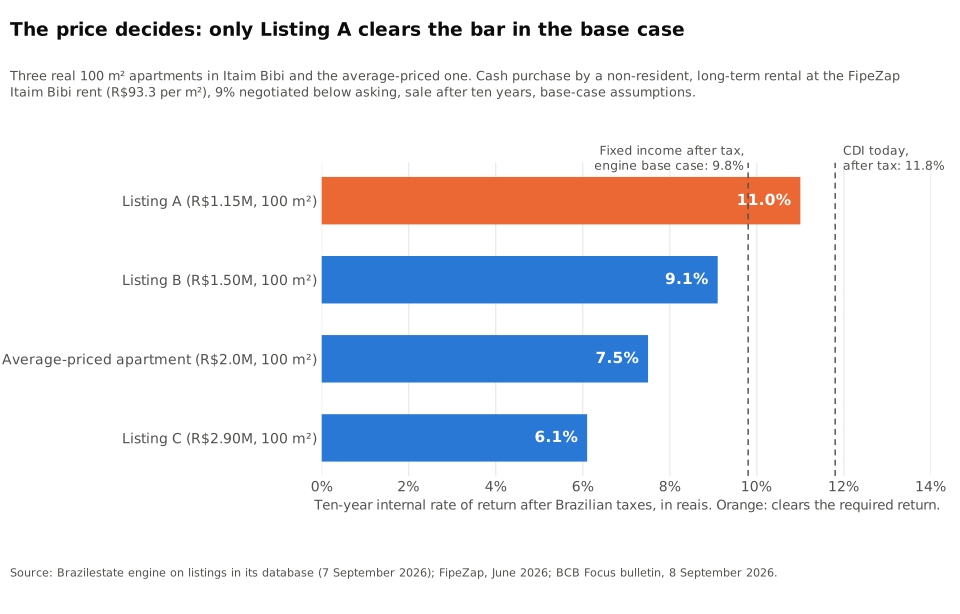
The yardstick, explained in part 1, is Brazilian fixed income: the CDI, the overnight interbank rate Brazilian savings products track, is about 13.9% a year in September 2026, and the engine's base case assumes it averages 11.5% over ten years, roughly 9.8% after tax. At Itaim Bibi's average price an apartment does not clear it, returning 7.5% a year after tax over ten years. Short-term letting can move that in the right building; we come to it below.
Why the average is the wrong question
Here is what the market looks like when you stop averaging. Our database holds 522 asking prices for apartments of 80 to 120 m² in Itaim Bibi: the tenth percentile is R$11,937 per m², the median R$16,186, the ninetieth percentile R$32,363. Similar apartments a few streets apart, at prices that differ by a factor of three.
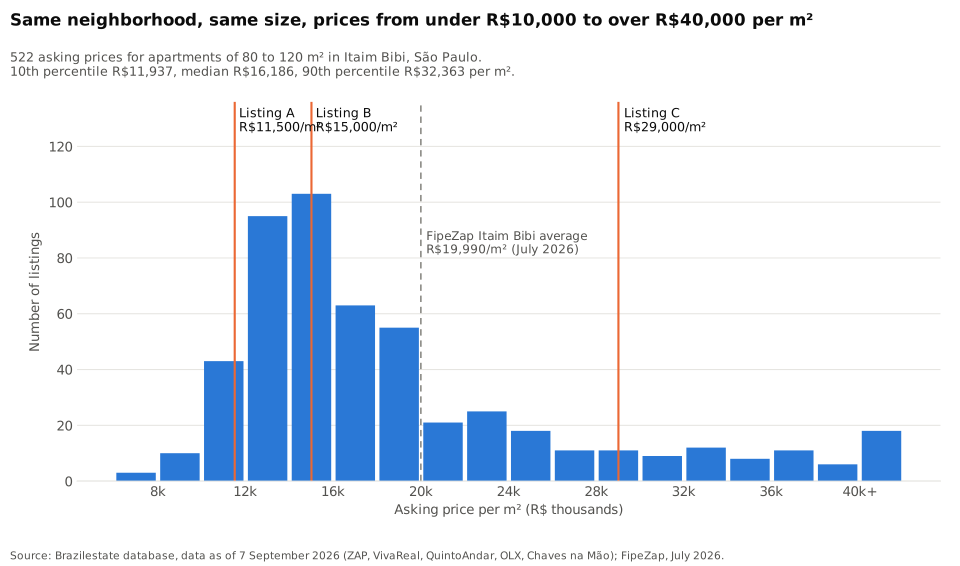
Some of that spread is real: a new building against a forty-year-old one, a high floor against a ground floor on a busy street, a renovated kitchen, two parking spaces. A lot of it is not: sellers anchoring on what they paid, brokers pricing for negotiation room, listings that have sat for a year with nobody adjusting them. For a buyer the spread is the opportunity: the rent does not move nearly as much as the price, so the yield moves with what you pay.
The useful question is not whether Itaim Bibi is a good investment but which of those 522 apartments is. That needs a method that works on one listing at a time. Here it is, on three of them.
Three real listings, one method
All three are apartments of 100 m² of área útil (the private usable area Brazilian listings quote, excluding common areas) in Itaim Bibi, listed between 29 August and 3 September 2026 and in our database on 7 September. Prices are asking prices: A is the cheap one, B sits near the median for its size, C is the expensive one.
| Listing A | Listing B | Listing C | |
|---|---|---|---|
| Asking price | R$1,150,000 | R$1,500,000 | R$2,900,100 |
| Price per m² | R$11,500 | R$15,000 | R$29,001 |
| Bedrooms, parking | 3, 1 | 3, 1 | 2, 2 |
| Street | Rua Itacema | Rua Bandeira Paulista | Rua Leopoldo Couto Magalhães Júnior |
| Condomínio (monthly building fee) | R$1,300 | R$1,083 | R$2,242 |
| IPTU (monthly municipal property tax) | R$209 | R$230 | R$755 |
| Source | VivaReal | ZAP Imóveis | ZAP Imóveis |
Run this on a real apartment, with your own tax status and holding period.
A and B are three-bedroom apartments in older buildings a few streets apart. C is a newer building with a second parking space, at two and a half times A's price per square meter.
The buyer in every case is a non-resident individual paying cash; mortgages are rarely available to non-residents, and at Brazilian rates a loan would cost more than the property yields. Assumptions are the base case of the Brazilestate engine, each published with its source and date: a 9% negotiation below asking (in FipeZap's Raio-X survey of the first quarter of 2026, 67% of buyers who had bought in the previous twelve months negotiated a discount), rent growing with inflation at 4.5% a year, the value at 6%, half a month of vacancy a year, 1% of the value for upkeep. Part 1 sets them out in full.
The rent is FipeZap's asking rent for Itaim Bibi, R$93.3 per m² per month in June 2026: R$9,330 a month for 100 m², the same for all three. That is the neighborhood rate, not the building's, so it may understate C, whose newer building could command a premium. The anchor holds up against live advertisements: of 175 rental listings we read on 10 September 2026, the 73 unfurnished ordinary apartments among them asked a median of 1.04 times the FipeZap rate for their neighborhood. How much of one it would need is in the numbers below.
Year one for Listing A, line by line
| Item | Year 1, in Brazilian reais (BRL) |
|---|---|
| Price paid (asking less 9%) | 1,046,500 |
| ITBI, the municipal transfer tax, 3% in São Paulo | 31,395 |
| Escritura and registration (the notarized deed and its entry on the matrícula, the registry file that proves ownership), about 2% | 20,930 |
| Total outlay | 1,098,825 |
| Rent collected, 11.5 months at R$9,330 | 107,295 |
| Placement-fee allowance, 3.3% of collected rent, one month's fee per 30-month lease | -3,541 |
| Condomínio and IPTU during the half month of vacancy | -755 |
| Insurance (0.02% of the price per month) | -2,512 |
| Upkeep and repairs (1% of the value a year) | -11,093 |
| Operating cash before tax | 89,395 |
| Income tax, non-resident: 15% of the rent after the letting fee and the vacancy charges | -15,450 |
| After-tax operating cash | 73,945 |
Calculations use unrounded amounts and the table shows them rounded, so a line can differ by a real or two. That is 6.7% of the outlay in cash, after tax, in year one. Two Brazilian features help: in the standard lease the tenant pays the ordinary condomínio and, by a clause in nearly every contract, the IPTU, so the owner carries those only while the flat is empty, though extraordinary condominium charges stay with the owner throughout (Tenancy Law, articles 22 and 23); and there is no annual wealth tax.
The tax line is the one foreigners get wrong. A non-resident pays 15% of the rent, withheld at source in the month it is received, or 25% from a jurisdiction Brazil lists as low-tax, and the base is the rent less the charges the owner actually bears (Income Tax Regulation, articles 42 and 763). Here the tenant pays the condomínio and the IPTU, so the only deductions are the letting fee and the charges on the empty half month, which is why the line is R$15,450 rather than 15% of the full R$107,295. A resident pays the progressive table instead, which on this rent comes to somewhat more; part 1 has both cases.
It also appreciates on paper: at 6% a year it is worth R$1,109,290 after twelve months, a gain of R$62,790 you collect only when you sell. The model grows the negotiated price at the market rate and counts nothing for the gap between A's R$11,500 per m² and the neighborhood's average near R$20,000. Part of that gap is a worse flat, as the spread section explains; if part of it is mispricing, that upside is not in these numbers.
Ten years, then the sale
Let the rent grow with inflation and the value grow 6% a year, and sell in year ten. Listing A is then worth about R$1,874,000. The broker takes 6%, and the gain, the sale price less selling costs less the R$1,098,825 you paid and can document, is taxed at 15%, or 25% from a listed low-tax jurisdiction, withheld by the buyer or the buyer's attorney-in-fact on the day of the sale, with none of the exemptions residents use (Carvalho Barros, 22 August 2026, citing Normative Instruction SRF 208/2002; part 1 has the detail).
Net proceeds from the sale: about R$1,662,000. Add ten years of after-tax rent, R$73,900 in year one rising to R$107,600 in year ten, and the internal rate of return (IRR, the single annual rate that summarizes all the cash in and out) is 11.0% a year, after all Brazilian taxes, in reais.
Listing B, 30% dearer: 9.1%. Listing C: 6.1%. The average-priced apartment at R$2 million: 7.5%.
The CDI test
To compare with fixed income we discount each apartment's cash flows at 10.3% a year, the after-tax CDI path of 9.8% plus half a point for the extra risk and work, and read the net present value (NPV): the amount, in today's reais, by which the apartment beats or trails that required return.
| Listing (100 m², Itaim Bibi) | Price per m² | Ten-year IRR after tax | NPV against fixed income | Rent needed to break even |
|---|---|---|---|---|
| A, R$1,150,000 | R$11,500 | 11.0% | +R$54,000 | 0.91 times (R$85 per m²) |
| B, R$1,500,000 | R$15,000 | 9.1% | -R$121,000 | 1.19 times (R$111 per m²) |
| Average-priced apartment, R$2,000,000 | R$20,000 | 7.5% | -R$374,000 | 1.59 times (R$148 per m²) |
| C, R$2,900,100 | R$29,001 | 6.1% | -R$828,000 | 2.3 times (R$215 per m²) |
Listing A clears the 10.3% required return with about R$54,000 to spare over ten years, and the negotiation is what puts it over the line: at the full asking price its NPV is roughly zero. Listing B trails by R$121,000, and a rent 20% above the neighborhood rate, which a well-kept building on a good street can command, closes that gap, so B is a viewing. Listing C trails by R$828,000 and would need R$215 per m², nearly twice what Leblon, the most expensive neighborhood in Brazil, averages. Nothing in our data supports a premium that large, and the price per square meter decided the outcome before the first tenant moved in.
How rare is a Listing A? We ran the same test on every listing in our database, using each neighborhood's FipeZap rent: in Itaim Bibi 150 of 1,542 pass, about one in ten; in Pinheiros, where prices are lower and rents higher, 255 of 1,217, one in five. They are ordinary three-bedroom flats in older buildings, priced to sell.
That screen is fixed so you can check it: our saved listing data from 7 September 2026; no coberturas; listings active, new or updated; asking price, área útil, condomínio and IPTU all present; no auction lots; 20 to 400 m²; R$3,000 to R$60,000 per m². A listing passes when its ten-year NPV is above zero for a non-resident paying cash at the base case, after the 9% negotiation.
Now change the view on rates, which is what everything hangs on. Each line keeps Listings A and C and changes only the rate path and what follows from it.
| Scenario, engine assumptions | Average CDI | Value growth | A: IRR | A: NPV | C: NPV |
|---|---|---|---|---|---|
| Rates stay high | 15% | 3% | 10.1% | -R$203,000 | -R$1,439,000 |
| Engine base case | 11.5% | 6% | 11.0% | +R$54,000 | -R$828,000 |
| Rates ease | 9% | 8% | 11.9% | +R$348,000 | -R$147,000 |
| Rates ease further | 7% | 9% | 12.5% | +R$621,000 | +R$478,000 |
Read it from the bottom up. If Brazil's rates fall that far over the decade, even Listing C works, because lower rates push prices up from two sides at once: the yardstick falls and the appreciation rises. If rates stay where the market expects, only the cheap listings work. Buy at Listing A's price per square meter and you are ahead in the base case and far ahead if rates fall, while the rate shock shows up as a R$203,000 shortfall against the bar rather than a collapse in the modeled value. None of these are guarantees about your capital. Pay a price that survives the base case, and let the rate cycle be your upside rather than your rescue.
Beyond the neighborhood: four factors that move the rent
The neighborhood rate is where the rent estimate starts, not where it ends. Two 100 m² apartments in Itaim Bibi can rent for very different amounts, and the difference comes from four things a listing rarely states:
Building standard. A 24-hour doorman, a pool, a gym, a party room, a sauna, a garden: each adds to what a tenant will pay and to the condomínio that pays for it.
Building age. A building from the last ten years rents for more than one from the 1970s with the same floor plan, until a full renovation narrows the gap.
Floor. Higher floors rent for more, for the light, the quiet and the view; a top-floor cobertura (penthouse) is a category of its own.
Renovation state. A recently renovated kitchen and bathrooms lift the rent immediately and the sale price later.
Brazilestate scores each factor and multiplies them into one premium score. A score of 1.0 means the neighborhood rate; a bare, forty-year-old ground-floor flat scores below it, a new, well-equipped, high-floor, renovated one well above, and the rent, the nightly rate and the NPV move with the score. It is calibrated against our own database, where thousands of asking prices show what the market pays for each factor.
Whether we can compute it depends on the ad. The score appears on each listing's detail card, and in the ranking itself where the ad gives us the building facts, which today is a small minority of them; everywhere else it sits at 1.0. Closing that gap is one of the things signed-in visitors can request: on any apartment a signed-in visitor is considering, we go back to the broker for the facts the ad leaves out, the floor, the age, the state of the renovation, the parking, and score the unit before the numbers are run.
For the three listings above the score is 1.0, because their ad pages do not give the data; the break-even column is the honest substitute. C's newer building will score above 1.0, and the table shows how far that has to go: 2.3 times the neighborhood rate is beyond anything our scoring has produced. The premium for quality is real, and larger on the short-stay side (in our review of Airbnb asking prices in August 2026, the three best-earning listings in each neighborhood charged 1.5 to 2.2 times the median nightly rate for their size), but whether the income premium exceeds the price premium is what the calculation must settle, one apartment at a time.
Short stays: the upside that depends on the building's papers
Short-term letting is the first thing a broker will mention. Two facts decide whether it is real.
The first is arithmetic. On our calibration (median all-in nightly rates asked on Airbnb in Itaim Bibi in August 2026, meaning the total a guest pays, cleaning and service fees included, divided by the nights booked; 18 nights a month, 16% deducted for the platform, then turnover costs, the owner paying condomínio, IPTU and utilities), Listing A run as a short-stay flat produces about R$96,000 of after-tax operating cash in year one instead of R$73,900, a 30% uplift, after R$90,000 of furnishing. Its NPV rises from plus R$54,000 to plus R$123,000. That is real, and it is not the doubling in the brokers' pitch decks: the platform takes 16% before the money arrives, and cleaning, utilities and the building costs the tenant used to pay take about 30% of the rest. A well-run premium cobertura can beat every number here; that is a business, and these numbers are for an owner who runs the letting himself. A full-service short-stay manager charges around 18% of revenue, and that fee comes out of the uplift above.
The second is permission. On 7 May 2026 the Superior Tribunal de Justiça (STJ, Brazil's highest court for non-constitutional matters) held that short-stay letting is an economic use that changes a residential building's purpose, so it takes a two-thirds vote of the owners to allow it (STJ, Second Section, REsp 2.121.055). A convention that is silent therefore prohibits it. A broker's assurance is worth nothing; only the convention or a registered assembly minute counts. So every listing on Brazilestate carries a four-state short-stay status (allowed, prohibited, reported, unknown) with an evidence grade, and the ranking counts Airbnb income only when the status is allowed. For listings signed-in visitors are interested in we read the building's convention and recent assembly minutes ourselves, so the short-stay case rests on a document, not an opinion. Our article on the ruling explains what to ask for.
There is also a segment built for this. São Paulo has thousands of studios of 25 to 40 m² in Pinheiros, Itaim Bibi and Vila Olímpia, sold as investor apartments and marketed for short stays. Their attraction is yield: a 25 m² studio listed at R$367,000 in Pinheiros on 8 September 2026, with a condomínio of R$261 and IPTU of R$40 a month, rents long term for about R$2,448 at FipeZap's Pinheiros rate, on a premium score of 0.99 from its own ad facts, a gross yield of 8.1% at asking against 5.6% for a typical Itaim Bibi flat. Two cautions. On our calibration the short-stay and long-term cases come out level for a unit that small (about R$18,500 a year after tax either way), because nightly rates fall with size while cleaning, utilities and the building fee do not: buy studios for the yield, not for an Airbnb premium. And "marketed for short stays" and "authorized in writing" are different things.
Why São Paulo
São Paulo is the largest city in the Western Hemisphere (11.45 million people, IBGE 2022 census), the business capital of Latin America, home to the Faria Lima financial district that runs through Itaim Bibi and to the world's largest urban helicopter fleet. On the Hurun Global Rich List 2026 it has 41 billionaires, more than Los Angeles (40), Stockholm (29) or Milan (28). And it is cheap for what it is: Itaim Bibi costs US$3,920 per m², about a third of Madrid's best district, a quarter of Manhattan and a ninth of Mayfair, with the full comparison and the charts in part 1. None of this says prices must rise; when Brazilian assets reprice they do it quickly, and the arithmetic above is what protects you if they do not.
How we found Listing A
Rank by price per square meter inside the neighborhood and look hard at the bottom third. Ask why each one is cheap: a noisy street is a reason to pass; an estate sale, a seller abroad or a listing that has sat for a year is a reason to bid.
Take the carrying costs from the listing, not from an average. Condomínio and IPTU vary from R$600 to R$2,500 a month for the same size in one neighborhood.
Start from the FipeZap rent, then score the building. Standard, age, floor, renovation; ask the broker what the listing does not say.
Run the CDI test under your own rate scenario, after tax, for your own tax status.
Check the building's paper before you count any short-stay income. Convention and assembly minutes, in writing.
Negotiate. Two thirds of the buyers in FipeZap's survey negotiated a discount, and for Listing A the 9% is the difference between passing and not.
This is what Brazilestate does to every listing in its coverage: it ranks them by NPV under the scenario you choose, with your tax status, the listing's own condomínio and IPTU, the FipeZap rent for its neighborhood, adjusted by the premium score where the ad page supports one, and every assumption open to change; it marks the short-stay status with an evidence grade, verified for signed-in visitors who ask; and it prices auctions at their opening bid. Listings A, B and C are in the ranking as L382, L7787 and L7952, ads that can sell or be withdrawn at any time, and for signed-in visitors we run the same numbers on any apartment they are looking at, in our database or not. Run your own assumptions on the ranking and shortlist what passes before you read the brochure.
For an apartment you are serious about, we can verify the price, the area and the short-stay rules with the broker before you offer. Ask through the property's page.
Perguntas frequentes
How much does an apartment cost in Itaim Bibi, São Paulo?
FipeZap's average asking price was R$19,990 per m² in July 2026 (FipeZap), about US$3,920. In our database (7 September 2026) apartments of 80 to 120 m² run from under R$10,000 to over R$40,000 per m², median R$16,186.
What rent does a 100 m² apartment in Itaim Bibi get?
About R$9,330 a month at FipeZap's June 2026 asking rent of R$93.3 per m² (FipeZap rental index), more in a newer building on a high floor, less in an older one at street level. The tenant pays the condomínio and the IPTU on top.
Is buying an apartment in São Paulo a good investment?
At the neighborhood's average price, no. In the engine's base case an average-priced Itaim Bibi apartment returns a modeled 7.5% a year after tax over ten years, against an assumed 9.8% after tax in Brazilian fixed income, with the Selic, Brazil's policy rate, at 14.00% since 5 August 2026. In that base case 150 of 1,542 Itaim Bibi listings pass, Listing A among them; faster easing improves every listing, but we have not calculated how many would then pass.
Is Airbnb allowed in São Paulo apartments?
In a residential building, only where the convention or a registered assembly minute authorizes the use. Since the STJ's ruling of 7 May 2026, running a unit as short-stay accommodation is treated as a change of the building's use, which takes a two-thirds vote of the owners (STJ, REsp 2.121.055). Where it is allowed, a 100 m² Itaim Bibi flat earns about 30% more after tax on our August 2026 calibration.
Are investor studios in São Paulo a good investment?
The Pinheiros studio above shows an asking-price gross yield of about 8% against 5.6% for a typical Itaim Bibi flat, but on our calibration a 25 m² unit earns about the same after tax let long term or short term, so the case rests on the yield, not on an Airbnb premium.
Educational content, not legal, tax or investment advice. Returns are model outputs under stated assumptions, not forecasts or promises. Listings A, B and C are real asking prices from public portals as of 7 September 2026 and may have changed or sold since. Figures as of 9 September 2026.
Sources. Our own review of 175 live rental advertisements, 10 September 2026; FipeZap venda, July 2026; FipeZap locação, June 2026; Banco do Brasil, Copom, 5 August 2026; Jornal do Comércio, Focus, 8 September 2026; InfoMoney, dollar close, 8 September 2026; Global Property Guide, prices, July 2026 and taxes and costs; idealista, Madrid, August 2026; PropertyShark, Manhattan, Q2 2026; LonRes, prime London, winter 2025/26; Visual Capitalist, Hurun Rich List 2026; Carvalho Barros, August 2026; STJ, Second Section, REsp 2.121.055, 7 May 2026; Income Tax Regulation, articles 42, 744 and 763; Tenancy Law 8.245/1991; FipeZap Raio-X, first quarter 2026; Exame, helicopter fleet, October 2025; IBGE, São Paulo panorama; Brazilestate database (data as of 7 September 2026), the Airbnb asking-price review of August 2026, and engine defaults.