Somente em inglês
Is property in Brazil a good investment? The after-tax answer for 2026, and how to find the apartments that pay
Atualizado em . Tempo de leitura 18 minutos.
Part 1 of 2. Part 2 runs three real São Paulo listings through the full calculation. Leia a outra parte.
Educational content, not advice; every figure is dated and linked to its source. This is part 1 of 2; part 2 runs three real São Paulo listings through the full calculation.

Every number below comes from the same database that ranks about 13,000 São Paulo and Rio listings by return after costs and tax. You can run it yourself.
The short answer
No, not the average one. With the policy rate at 14.00%, a Brazilian bank deposit tracking the CDI pays about 13.9% a year before tax, and an average-priced apartment in the prime neighborhoods of São Paulo and Rio does not come close to that after tax. Nothing in Brazilian real estate can be judged without that number: it is what every local investor compares a property with, and local investors set the prices you will buy and sell at.
Here is what that comparison says for a 100 m² apartment bought 9% below the average asking price of its neighborhood, rented long term at the neighborhood's average rent, by a non-resident paying cash, over ten years, after every Brazilian tax. Figures are in Brazilian reais (BRL), shown as R$, and the method is explained below.
| Neighborhood | Average price, 100 m² | Gross rental yield | After-tax cash, year one | Ten-year IRR after tax | Against fixed income (NPV) |
|---|---|---|---|---|---|
| Itaim Bibi, São Paulo | R$1,999,000 | 5.6% | 3.3% | 7.5% | -R$374,000 |
| Pinheiros, São Paulo | R$1,830,200 | 6.5% | 4.1% | 8.3% | -R$251,000 |
| Jardins, São Paulo | R$1,783,300 | 5.6% | 3.3% | 7.5% | -R$338,000 |
| Leblon, Rio de Janeiro | R$2,843,200 | 5.2% | 3.0% | 7.2% | -R$599,000 |
| Ipanema, Rio de Janeiro | R$2,617,800 | 5.4% | 3.2% | 7.4% | -R$520,000 |
| Copacabana, Rio de Janeiro | R$1,347,900 | 6.6% | 4.2% | 8.4% | -R$174,000 |
| Botafogo, Rio de Janeiro | R$1,313,400 | 6.8% | 4.3% | 8.5% | -R$155,000 |
| Flamengo, Rio de Janeiro | R$1,249,200 | 6.5% | 4.1% | 8.2% | -R$172,000 |
Change the assumptions and see which apartments still work at your own hurdle rate.
Brazilestate engine, base case. The price column is the neighborhood's average asking price; the purchase is modeled 9% below it. Prices and rents: FipeZap, July and June 2026. Building fees (condomínio) and municipal property tax (IPTU): medians in the Brazilestate database. Fixed income after tax: 9.8% a year, see below.
Every line loses. The last column is the shortfall, in today's reais, against the 10.3% a year we require of a property: the after-tax fixed-income path of 9.8% plus half a point for the extra risk and work. That is why so much Brazilian capital sits in fixed income rather than in bricks.
But the average is not for sale. Specific apartments are, at prices all over the place. Our database holds 522 asking prices for apartments of 80 to 120 m² in Itaim Bibi, São Paulo's financial district: the tenth percentile is R$11,937 per m², the median R$16,186, the ninetieth percentile R$32,363. Run the same test on every listing with complete cost data and 150 of 1,542 in Itaim Bibi pass, about one in ten, and 255 of 1,217 in Pinheiros, one in five. They are ordinary three-bedroom flats in older buildings, priced to sell. Part 2 takes three of them, line by line.
What the market looks like in September 2026
Prices. FipeZap, the index of asking prices published monthly by the University of São Paulo's Fipe institute and the ZAP portal, puts the São Paulo average at R$12,099 per square meter in July 2026, up 3.70% over twelve months. Its São Paulo table is led by Itaim Bibi at R$19,990 per m², Pinheiros at R$18,302 and Jardins at R$17,833. In Rio de Janeiro the city average is R$11,131 (up 4.72%), led by Leblon at R$28,432 and Ipanema at R$26,178. Our own database shows medians of R$19,667 per m² across 2,066 Itaim Bibi listings and R$18,443 across 2,032 in Pinheiros, so the two sources agree.
Rents. FipeZap's rental index rose 5.73% in São Paulo and 11.65% in Rio in the year to June 2026. Asking rents average R$93.3 per m² per month in Itaim Bibi, R$98.9 in Pinheiros, R$82.7 in Jardins; in Rio, R$122.5 in Leblon, R$117.4 in Ipanema, R$74.6 in Copacabana, R$74.9 in Botafogo. We checked that anchor against the live market on 10 September 2026: of 175 rental advertisements we read, the 73 unfurnished ordinary apartments among them asked a median of 1.04 times the FipeZap rate for their neighborhood.
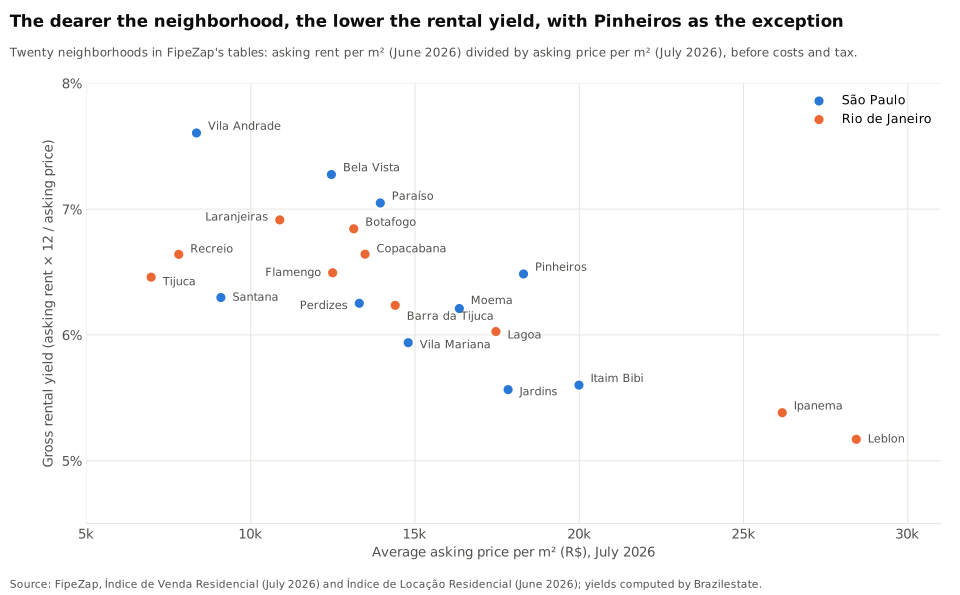
Yields. Asking rent divided by asking price gives the gross rental yield: 6.43% a year for São Paulo and 6.25% for Rio. In FipeZap's tables the dearest neighborhoods mostly yield least: Itaim Bibi 5.6%, Jardins 5.6%, Leblon 5.2% and Ipanema 5.4%, against 7.3% in Bela Vista, 7.0% in Paraíso, 6.9% in Laranjeiras and 6.8% in Botafogo. Pinheiros is the exception, second dearest in São Paulo and still yielding 6.5%. The chart plots all twenty.
Interest rates. The Selic is the Central Bank's policy rate; the Copom is the committee that sets it eight times a year. On 5 August 2026 the Copom cut the Selic to 14.00%. The CDI, the overnight interbank rate and the reference for almost every savings product, runs a fraction below: as of September 2026 it is about 13.9%. The Focus bulletin, the Central Bank's weekly survey of market forecasts, put the Selic at 13.75% for the end of 2026 on 8 September, and recent bulletins have it at 12% for the end of 2027.
Inflation and currency. The IPCA, Brazil's consumer price index, rose 4.4% in the twelve months to July 2026 (Ministry of Finance on the July release). The dollar bought about R$5.10 on 8 September 2026.
Put together: São Paulo asking prices rose slower than inflation over the year and Rio's a little faster, rents rose faster than prices in both cities, and the risk-free rate is almost 14% against inflation under 4.5%. That last gap is the whole story.
The CDI test, explained
A Brazilian investor does not ask whether a 7% or a 10% return is good on its own. She asks whether it beats the CDI, which takes a few clicks, no tenant and no notary. As of September 2026 the CDI is about 13.9%, or 11.8% after the 15% tax on fixed income held longer than two years. The engine's base case assumes it averages 11.5% over the next ten years, in line with the market's expectation that rates fall, which is roughly 9.8% after tax. Add half a point for the extra risk and work of owning a flat and the bar every apartment here is measured against is 10.3% a year.
We build the apartment's cash flows for ten years and the sale at the end, after every cost and tax, and discount them at that 10.3%. The result is the net present value (NPV): the amount, in today's reais, by which the apartment beats or trails that required return. The internal rate of return (IRR) is the same calculation as a single annual rate; the table above shows both.
The engine's base case, every item published with its source and date and open to change: a 9% negotiation below asking (in FipeZap's Raio-X survey of the first quarter of 2026, 67% of buyers who had bought in the previous twelve months negotiated a discount); ITBI, the municipal transfer tax, 3% in São Paulo; about 2% for the escritura (the notarized deed) and its registration on the matrícula (the property's registry file, which is what proves ownership); the neighborhood's FipeZap rent, growing with inflation at 4.5% a year; half a month of vacancy a year; a broker's placement fee of one month per new lease; insurance; 1% of the value a year for upkeep; the value growing 6% a year (FipeZap's São Paulo index rose 6.56% in 2024 and 4.56% in 2025); a 6% brokerage on the sale; and the taxes in the next section.
Two Brazilian features work in the owner's favor. In the standard Brazilian lease the tenant pays the ordinary condomínio (the monthly building fee) and, by a clause found in nearly every contract, the IPTU (the municipal property tax); the owner carries those while the flat is empty, and always carries extraordinary condominium charges such as facade works or a new lift (Tenancy Law, articles 22 and 23). And there is no annual wealth tax on property.
The taxes a foreign owner pays
On rent. A non-resident individual pays 15% of the rent, withheld at source in the month it is received, or 25% if resident in a jurisdiction Brazil lists as low-tax. The base is the rent less the charges the owner actually bears: property taxes and fees, the condominium, the cost of collecting the rent, and rent paid on a sublease (Income Tax Regulation, articles 42 and 763). In a standard lease the tenant pays the condomínio and the IPTU, so those are not the owner's to deduct; what usually is deductible is the letting agent's fee and the charges on the months the flat sits empty. A Brazilian resident pays the progressive table instead, up to 27.5% after the same exclusions, with a reduction from 2026 that cancels the tax up to R$5,000 of monthly taxable income and tapers away by R$7,350 (Law 15.270/2025). On a prime apartment renting for R$9,000 a month the resident pays somewhat more than the non-resident.
On the sale. The capital gain, the sale price less selling costs less the acquisition cost you can document, is taxed at 15% for a non-resident, rising through 17.5%, 20% and 22.5% in bands above R$5 million of gain, or 25% throughout for a resident of a listed low-tax jurisdiction. Keep the deed, the exchange contracts and the invoices for what you spent on the flat, because the basis is what you can prove. Neither of the two exemptions Brazilians use, the R$440,000 sole-property rule and the 180-day reinvestment rule, applies to non-residents, and the buyer or the buyer's attorney-in-fact withholds the tax on the day of the sale (Carvalho Barros Advogados, 22 August 2026, citing Normative Instruction SRF 208/2002).
On the purchase. ITBI of 3% in São Paulo plus about 2% for deed and registration: budget 5% on top of the price. The broker's commission, usually 6%, is paid by the seller. A lawyer's due diligence, the certificates and the matrícula check described in our risk checklist, costs a few thousand reais and is the best money in the deal.
The interest-rate view that decides everything
The table at the top uses the engine's base-case rate path. Change the path and the answer changes, because lower rates push property up from two sides at once: the yardstick falls and the appreciation rises. In part 2 the cheapest of three real listings goes from plus R$54,000 against fixed income in the base case to plus R$621,000 if Brazil converges to single-digit rates, and to minus R$203,000 if rates stay at 15%; the dearest only works in the convergence case. That asymmetry is the whole art of buying Brazilian property: pay a price that survives the base case, and let the rate cycle be your upside rather than your rescue.
As of September 2026 the Selic is 14.00%; the US Federal Reserve's target range is 3.50% to 3.75% and the European Central Bank's deposit rate is 2.25%. With inflation at 4.4%, Brazil's real interest rate is about 9.3%, second only to Russia's among the forty economies MoneYou and Lev Intelligence track (August 2026). The pressure to bring it down is political too, with a presidential election in October 2026 and the president tying faster cuts to fiscal discipline on 5 August. The Central Bank is formally autonomous and the consensus is a slow glide to 12% by the end of 2027; a buyer who expects faster is betting against it, and part 2 shows what the bet pays.
The currency. Everything above is in reais. Brazil pays 14% for a reason: a dollar cost about R$1.70 in 2011 and about R$5.10 in September 2026, so a 10% return in reais can be a great or a poor return in dollars. Treat the currency as a separate decision, and never let a broker fold an exchange-rate forecast into a rental yield.
Short stays: the upside that depends on paper
Short-term letting is the first thing a broker will mention, and it can change the arithmetic: on our calibration a well-priced 100 m² flat in Itaim Bibi earns about 30% more after tax as a short-stay flat than as a long-term rental, after R$90,000 of furnishing and after the platform's 16% fee, the turnover costs and the bills the owner takes back from the tenant. Permission decides whether any of it counts. On 7 May 2026 the Superior Tribunal de Justiça (STJ, Brazil's highest court for non-constitutional matters) held that running a unit in a residential building as short-stay accommodation changes the use the building was set up for, so it takes a two-thirds vote of the owners to allow it (STJ, Second Section, REsp 2.121.055). A convention that says nothing is not permission. A broker's assurance is worth nothing; only the convention or a registered assembly minute counts, and our article on the ruling explains what to ask for.
What Brazil costs against the world
São Paulo is the largest city in the Western Hemisphere (11.45 million people, IBGE 2022 census). Its apartments are cheap by the standards of comparable cities, on both measures that matter.
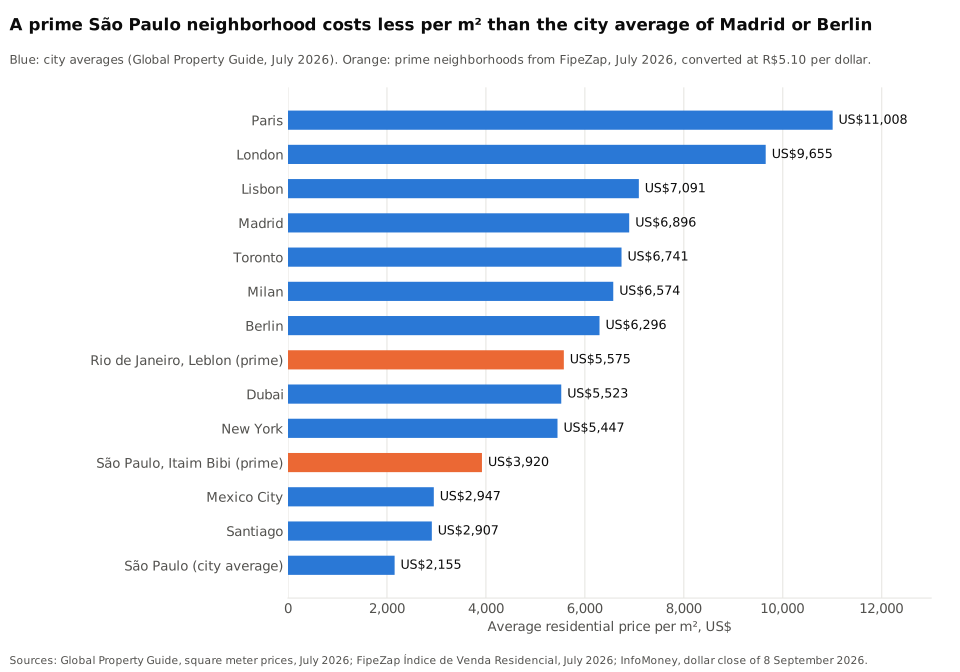
Measure one, city average against city average. Global Property Guide's July 2026 survey puts the average apartment at US$2,155 per m² in São Paulo, against US$5,447 in New York, US$6,896 in Madrid, US$9,655 in London and US$11,008 in Paris. Itaim Bibi, the most expensive neighborhood in the city, is US$3,920 per m² at the September 2026 exchange rate: 28% below the New York average, 43% below Madrid and 64% below Paris. A prime São Paulo neighborhood costs less than an ordinary one in those cities.
Measure two, best district against best district, each at its own average, in US dollars at the European Central Bank's reference rates of 8 September 2026. Salamanca in Madrid asks €10,841 per m² (idealista, August 2026), about US$12,600; Manhattan closed at a median of US$1,433 per square foot in the second quarter of 2026 (PropertyShark), about US$15,400 per m²; Mayfair and St James's achieved £2,445 per square foot in 2025 (LonRes), about US$35,600 per m². Itaim Bibi at its average is US$3,920: a third of Salamanca, a quarter of Manhattan, a ninth of Mayfair. The chart adds six more cities, linked in the sources.
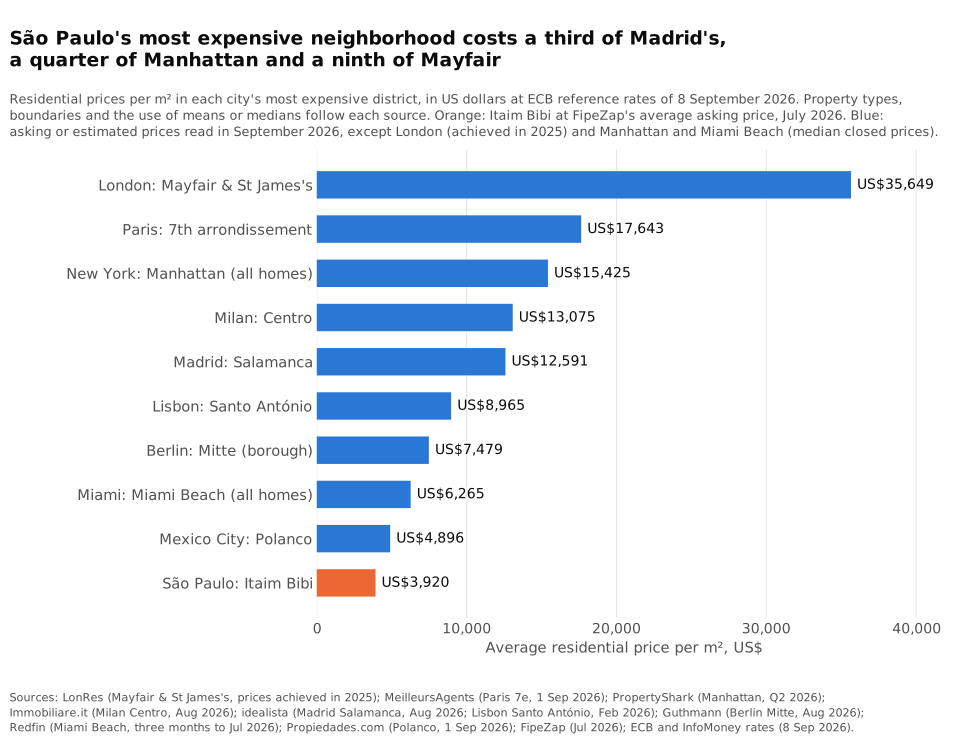
The bases differ, London being 2025 achieved prices and Manhattan and Miami Beach closed prices against asking or estimated prices elsewhere, and none of it changes the order of magnitude or says prices must rise. There are also reasons to own that are not returns: living in the flat part of the year, or the investor residence permit, which requires R$1,000,000 of urban real estate under CNIg Normative Resolution 36/2018. Those change what you are willing to pay, not the arithmetic.
How to find the ones that pass
Start from price per square meter inside the neighborhood, not its reputation. Rank every listing of the size you want by price per m² and look hard at the bottom third. Ask why each one is cheap: a noisy street is a reason to pass; an estate sale, a seller abroad or a listing that has sat for a year is a reason to bid.
Get the carrying costs from the listing, not from an average. Condomínio and IPTU vary from R$600 to R$2,500 a month for the same size in one neighborhood, and you carry both while the flat is empty.
Start from published rents, then adjust for the building. FipeZap publishes asking rents per m² by neighborhood every month; building standard, age, floor and renovation state move the rent from there, and part 2 explains how we score them.
Run the CDI test under your own rate scenario, after tax, for your own tax status. For a non-resident that is 15% withheld on the rent after the charges you bear, 15% on the gain rising through the bands above R$5 million, none of the exemptions residents use, and 25% throughout from a listed low-tax jurisdiction.
Check the building's paper before you count any short-stay income. Convention and assembly minutes, in writing.
Negotiate, and look at auctions. Two thirds of the buyers in FipeZap's survey negotiated a discount. Judicial and bank auctions publish an opening bid and an appraisal for every lot, and a discount deep enough is what makes an otherwise average apartment pass the test; check the opening bid, the appraisal, the fees and the arrears on the lot itself before you model it, and read the notice.
This is what Brazilestate does to every listing in its coverage: it ranks them by NPV under the scenario you choose, with your tax status, the listing's own condomínio and IPTU, the FipeZap rent for its neighborhood, and every assumption open to change; it marks the building's short-stay status with an evidence grade, verified for signed-in visitors who ask; and it prices auctions at their opening bid. During the pilot, for signed-in visitors we run the same numbers on any apartment they are looking at, in our database or not. Run your own assumptions on the ranking and shortlist what passes before you read the brochure.
Before you buy, in one paragraph
Get a CPF, the Brazilian taxpayer number, which a non-resident can obtain through a consulate. Bring the money in through a formal exchange contract in your own name, so you can take it, and the gain, back out. Check the matrícula and the seller's certificates before you sign anything, as our risk checklist sets out step by step. Budget 5% for ITBI, deed and registration, 15% withheld on the rent net of the charges you bear, and 15% on the gain, more in the bands above R$5 million or 25% throughout from a listed low-tax jurisdiction. Then run the numbers against the CDI, and take only what passes into due diligence.
If you shortlist a specific apartment, we can check its documents and confirm the facts before you commit. Ask through the property's page.
Perguntas frequentes
Is real estate in Brazil a good investment in 2026?
At the average price, no. In the engine's base case an average-priced apartment in the prime neighborhoods of São Paulo and Rio returns a modeled 7.2% to 8.5% a year after tax over ten years, against an assumed 9.8% after tax in Brazilian fixed income, with the Selic at 14.00% since 5 August 2026. Listings priced in the bottom third of their neighborhood (one in ten in Itaim Bibi, one in five in Pinheiros, in our database of 7 September 2026), buildings that expressly allow short stays, and auctions can pass, and every listing improves if rates fall faster than the market expects.
What is the rental yield in Brazil?
Gross asking yields were 6.43% in São Paulo and 6.25% in Rio in mid-2026 (FipeZap, June 2026); the dearest neighborhoods yield 5.2% to 5.6%, cheaper ones up to 7.6%. After costs and the non-resident's 15% withholding, an average-priced prime apartment pays 3% to 4.3% in cash in year one.
What tax does a foreigner pay on rental income in Brazil?
A non-resident pays 15% of the rent, withheld at source in the month it is received, or 25% from a listed low-tax jurisdiction. The base is the rent less the charges the owner actually bears, which are the property taxes and fees, the condominium, the cost of collecting the rent and any sublease rent paid (Income Tax Regulation, articles 42 and 763); in a standard lease the tenant pays the condomínio and the IPTU, so the owner cannot deduct them. Residents pay the progressive table up to 27.5% after the same exclusions, with a reduction from 2026 that cancels the tax up to R$5,000 of monthly taxable income and tapers away by R$7,350 (Law 15.270/2025).
What tax does a foreigner pay when selling property in Brazil?
15% of the gain up to R$5 million, then 17.5%, 20% and 22.5% in bands above it, or 25% throughout from a listed low-tax jurisdiction. The gain runs from the acquisition cost you can document, the buyer or the buyer's attorney-in-fact withholds on the day of the sale, and none of the exemptions residents use apply (Carvalho Barros, August 2026, citing Normative Instruction SRF 208/2002).
How do prices in Brazil compare with other countries?
São Paulo's average apartment costs US$2,155 per m² against US$6,896 in Madrid and US$9,655 in London (Global Property Guide, July 2026). Best district against best district, Itaim Bibi averages US$3,920 per m², about a third of Madrid's Salamanca and a ninth of Mayfair.
Educational content, not legal, tax or investment advice. Returns are model outputs under stated assumptions, not forecasts or promises. Figures as of 9 September 2026.
Sources. Our own review of 175 live rental advertisements, 10 September 2026; FipeZap venda, July 2026; FipeZap locação, June 2026; Banco do Brasil, Copom, 5 August 2026; Jornal do Comércio, Focus, 8 September 2026; InfoMoney, dollar close, 8 September 2026; ECB euro reference rates, 8 September 2026; Global Property Guide, prices, July 2026 and taxes and costs in Brazil; LonRes, prime London, winter 2025/26; MeilleursAgents, Paris 7e, 1 September 2026; PropertyShark, Manhattan, Q2 2026; Immobiliare.it, Milan, August 2026; idealista, Madrid, August 2026; idealista, Lisbon, February 2026; Guthmann, Berlin Mitte, August 2026; Redfin, Miami Beach, July 2026; Propiedades.com, Polanco, 1 September 2026; Carvalho Barros, August 2026; STJ, Second Section, REsp 2.121.055, 7 May 2026; Income Tax Regulation, articles 42, 744 and 763; Law 15.270/2025; Tenancy Law 8.245/1991; FipeZap Raio-X, first quarter 2026; Brazilestate database (data as of 7 September 2026) and engine defaults.