Somente em inglês
How a Brazilian property purchase goes wrong, and the checks that catch it
Atualizado em . Tempo de leitura 9 minutos.
Educational content, not legal advice; every rule is linked to its source.
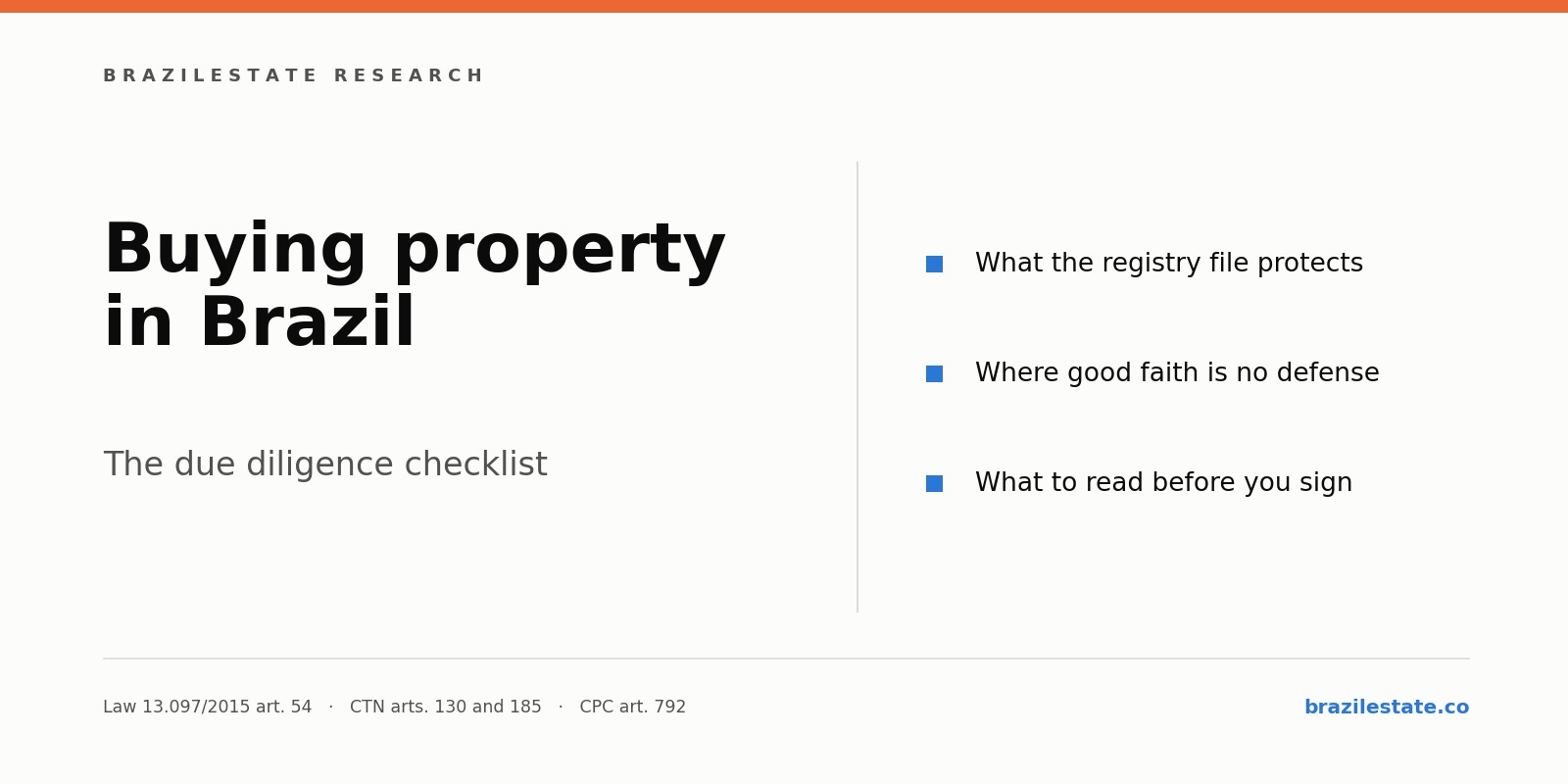
Yes, a completed purchase can be reversed in Brazil, and the circumstances are narrow enough to check for. Every foreigner eventually hears the São Paulo dinner-table story: someone bought an apartment, registered it, and years later lost it to the seller's old debts. It is not a myth. What it leaves out is how much the law already protects a buyer who bought openly.
Most of these risks are checkable before you bid. Start from the listings and their verified facts.
How a done deal can come undone
Three mechanisms matter, and each carries a condition.
Fraud against enforcement. If a seller transfers property while a lawsuit capable of ruining them is running, a court can declare the sale a fraude à execução and take the property from the buyer (Code of Civil Procedure, article 792). Not automatically: the STJ, Brazil's highest court for non-constitutional matters, requires the creditor to show either that the attachment was registered against the property or that the buyer knew (Súmula 375).
Tax debt. This one is stricter, and it is the exception to most of what follows. A sale by a taxpayer whose debt is already enrolled as dívida ativa, the register of enforceable public debt, is presumed fraudulent, and the statute's own escape is that the seller kept back assets or income sufficient to pay the enrolled debt in full (National Tax Code, article 185). Súmula 375 does not rescue the buyer here: for transfers made from 9 June 2005, the STJ held under Theme 290 that the enrollment alone triggers the presumption, with no need to prove the buyer acted badly. There is one narrow exception worth knowing: in June 2026 the First Panel protected a buyer who bought in good faith relying on a tax clearance certificate that the tax authority had issued in error, through its own fault alone (REsp 2.030.470). Short of that, a clean matrícula and your own good faith are not a defense here.
Creditors attacking the sale itself. A seller in debt who sells to put assets beyond reach can be attacked by those creditors for four years from the date of the sale, an ação pauliana (Civil Code, articles 158 to 165 and 178). Where the buyer paid a real price, they must also show the seller was insolvent and the insolvency known or knowable.
Separately, debts of the property follow the apartment rather than the person. Condominium arrears pass to whoever owns the unit (Civil Code, article 1.345), and unpaid municipal property tax, the IPTU, transfers with the property unless the deed carries proof of payment (National Tax Code, article 130). Lawyers call these obligations propter rem: they follow the thing, and good faith is no defense against them.
What the registry file protects, and what it does not
Here is the part the horror stories skip. Since Law 13.097/2015, article 54, Brazil follows the concentration principle: claims against a property belong on its matrícula, the file held at the cartório de registro de imóveis, the property registry office. Paragraph 1 says a situation that is not on the matrícula cannot be used against a buyer in good faith. Paragraph 2 says what foreign buyers are rarely told: establishing that good faith requires no court or distributor certificates, and no document beyond the ones the notary already asks for at the deed (Law 7.433/1985, article 1, paragraph 2).
Strong, and not complete. Article 54 carves out the clawback of transfers by a seller who later goes bankrupt (articles 129 and 130 of Law 11.101/2005), and every way of acquiring or losing ownership that does not depend on registration, adverse possession and inheritance among them. It does not reach tax enforcement, for the reason above. Nor can it stop a claim being filed, and a claim you win still costs years and fees. The propter rem debts ignore good faith entirely.
Certificates, in other words, are not the price of legal protection. They are how you find the problem while you can still renegotiate or walk away.
The checklist
For the property. An updated matrícula, read for liens, penhoras (court attachments), usufructs and pending annotations. The condominium debt declaration signed by the síndico, the elected building manager, or by the administrator. IPTU clearance from the city.
For the seller, the spouse, and the company if the seller is one. Federal, state and municipal tax clearance certificates. The labor-court certificate, which matters more in Brazil than foreign buyers expect, because labor debts are pursued aggressively. Civil and federal court distribution certificates where the seller lives and where the property sits. Protest registry certificates. If the seller bought recently, run the same logic one owner back.
For an auction (leilão). Read the edital, the auction notice, line by line: whether the unit is occupied, what fees you pay on top of the bid, your deadlines. What it cannot do is hand you the seller's old tax bill. In a judicial auction the property tax sub-rogates onto the sale price rather than the buyer (National Tax Code, article 130, sole paragraph), and on 9 October 2024 the STJ's First Section held unanimously, under Theme 1134, that an auction notice making the winning bidder liable for tax already charged on the property is invalid. That is judicial auctions; other kinds and older notices need their own reading. Condominium arrears sit on a separate footing either way.
One bad certificate is not a deal-killer by itself. A labor lawsuit against a solvent seller who owns ten properties is a different animal from one against a seller whose only asset is the flat you are buying. Judging that is a local property lawyer's job.
See what we already know about a property and what is still unverified, marked as such.
Where this fits in the numbers
Due diligence protects the purchase; it does not make a bad purchase good. An apartment that fails the arithmetic still fails it with a clean matrícula, which is why our after-tax analysis comes first and this checklist second, and why part 2 runs three São Paulo listings through the calculation. If short-stay income is part of your case, the 2026 STJ ruling explains what to demand of the building's paperwork.
During the pilot, for signed-in visitors we read the convention and the recent assembly minutes ourselves and record what they say with an evidence grade. The seller-side certificates above are a lawyer's job, not ours. Run your assumptions on the ranking first, then spend the legal budget on the one or two apartments that survive it.
Before you commit to one apartment, ask for a document check. We pull the matrícula and the convenção and tell you what they say.
Perguntas frequentes
Can a property purchase be reversed in Brazil?
Yes, in three defined circumstances, and they do not work alike. A sale made while the seller faced a ruinous lawsuit can be declared fraud against enforcement, but the creditor must show a registered attachment or that the buyer knew (article 792; Súmula 375). A sale designed to defeat creditors can be attacked for four years, on proof that the seller was insolvent and the insolvency knowable (Civil Code, articles 158 to 165 and 178). Tax is stricter: a sale by a taxpayer whose debt is already enrolled is presumed fraudulent, and good faith alone is not a defense unless the seller left assets or income sufficient to pay the enrolled debt in full (National Tax Code, article 185), or the narrow First Panel ruling applies, where the buyer bought in good faith relying on a clearance certificate the tax authority had issued in error through its own fault alone. Outside tax enforcement, article 54 protects the good-faith buyer against unrecorded claims, subject to its bankruptcy carve-out and to ownership changes that do not depend on registration (Law 13.097/2015, article 54).
Do I need certificates to buy an apartment in Brazil?
Some are required and most are not. The notary must see proof that the transfer tax was paid, the fiscal certificates and the certificates of ownership and of charges (Law 7.433/1985, article 1, paragraph 2). Beyond those, article 54, paragraph 2 of Law 13.097/2015 says establishing good faith requires no court or distributor certificates at all. Pull them anyway, as due diligence rather than as a legal condition: they are how you find a problem while you can still act on it. The full set is in the checklist above, and it covers the seller as well as the apartment.
Do condominium debts pass to the new owner?
Yes. Arrears attach to the unit (Civil Code, article 1.345), and unpaid IPTU transfers with the property unless proof of payment is presented at the deed (National Tax Code, article 130). Neither depends on what you knew, so ask for the declaration and the clearance before you sign.
If I buy at auction, do I inherit the old debts?
In a judicial auction covered by Theme 1134, the property taxes already charged attach to the sale proceeds rather than to you (National Tax Code, article 130, sole paragraph), and an auction notice saying otherwise is invalid. Other kinds of auction, and notices published before that judgment, need their own reading. Condominium arrears sit on a separate footing either way, so read the edital and price them in.
Do I need a lawyer to buy property in Brazil?
Nothing obliges you to use one, and the notary will not do this work for you. For a few thousand reais a local property lawyer reads the matrícula and the certificates and tells you what they mean. On a purchase of a million reais or more, declining that is the worst trade in the transaction.
Educational content, not legal advice. Rules summarized as of September 2026; case law and practice evolve.
Sources. Law 13.097/2015, article 54, concentration on the matrícula and the good-faith buyer; Law 7.433/1985, article 1, the documents a notary requires at the deed; Law 11.101/2005, articles 129 and 130, the bankruptcy clawback; Code of Civil Procedure, article 792 and STJ Súmula 375 of 18 March 2009; Civil Code, articles 158 to 165 and 178, and article 1.345; National Tax Code, articles 130 and 185; STJ, First Section, Theme 1134, REsp 1.914.902, REsp 1.944.757 and REsp 1.961.835, rapporteur Minister Teodoro Silva Santos, judged unanimously on 9 October 2024; STJ Theme 290, leading case REsp 1.141.990, on fraud in tax enforcement, and REsp 2.030.470, First Panel, rapporteur Minister Gurgel de Faria, decided by majority on 16 June 2026, on good-faith reliance on a tax clearance certificate.